

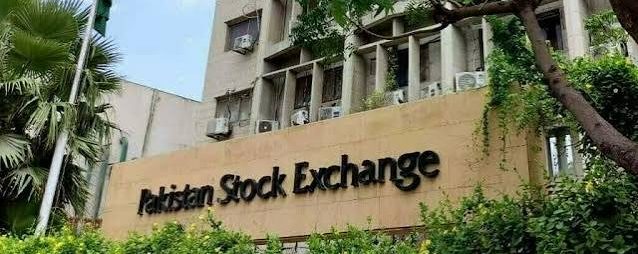
Karachi – The bearish trend continued on Wednesday at the Pakistan Stock Exchange, and major indices came under selling pressure. Weakness in the banking, investment, refinery and fertiliser sectors weighed on the overall market.
At the close of business, the benchmark KSE-100 index closed down 1,109.14 points at 176,846.36 points. Thus, the index recorded a daily decline of 0.62 percent. The data available from the Pakistan Stock Exchange also confirms the closing level.
The trading session was volatile. The KSE-100 started the day at 178,072.42 points and reached a high of 178,942.31 points during the trading session. Later, the increase in selling took the index to a low of 176,638.11 points.
Overall, among the 100 components of the KSE-100, shares of 32 companies closed in the positive zone, while 67 declined and one company did not change significantly in price. These figures indicate widespread selling pressure in the market.
The banking sector played the most prominent role in the decline of the index. Commercial banks had a negative impact of 533.56 points on the KSE-100. After this, the total negative contribution of investment companies and securities companies was 132.83 points.
The refinery sector added pressure on the index by shedding 115.36 points, while the fertilizer sector added 74.86 points. The cement sector also had a negative impact of 53.21 points.
On the other hand, some companies supported the market from falling further to a limited extent. Pakistan Petroleum Limited contributed 80.80 points positively. Pakistan Telecommunication Company contributed 31.71, DG Khan Cement 23.26, International Steels 22.20 and Fatima Fertilizer 18.51 points positively.
Among the prominent companies that contributed negatively, United Bank Limited was at the top, which lost 258.10 points from the index. This was followed by ENGROH at 119.55, Habib Bank at 105.70, FFC at 79.27 and Attock Refinery at 77.45 points.
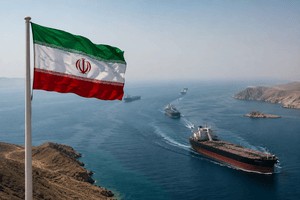
Global energy prices and the ongoing uncertainty in the region are also becoming important factors in the overall market trend. In recent days, the increase in oil prices and concerns about the Strait of Hormuz have re-emerged as external sector risks for investors. These factors also affected the market last week.
Apart from the KSE-100, the Islamic investment-based KMI-30 index was also under pressure. The index closed at 248,794.52 points after a decline of 1,628.55 points, or 0.65 percent. During the day, the KMI-30 opened at 250,936.66 points, while the highest level was 252,390.14 and the lowest level was 248,346.29 points.
In KMI-30, Pakistan Petroleum, DG Khan Cement and Airlink contributed positively, while ENGROH, Attock Refinery, Maple Leaf Cement, Mari Petroleum and FFC were the main drags on the index.
The volume of the index constituents in KSE-100 was 409.77 million shares. On the other hand, the volume of the index constituents in KME-30 was recorded at 113.36 million shares. The overall market also witnessed significant trading activity, however, the volume was lower compared to the previous session.
According to available market data, the KSE-100 is down 3,455 points or 1.92 percent so far this fiscal year, while the index is still up 2,792 points or 1.60 percent since the start of the calendar year. This indicates that despite the recent pressure, the overall trend for the year has not completely changed to the negative.
In the current situation, investors will focus on global oil prices, the geopolitical situation in the region, external accounts and corporate performance of major sectors. The future direction of the market will be determined by the reduction of selling pressure and the availability of new positive stimuli.
We welcome your contributions to The Pakistan Observer. Submit your blogs, opinion pieces, press releases and news features to our editorial team.
Please send your submissions to our News Desk or Editorial team. We look forward to hearing from writers, journalists and contributors.