


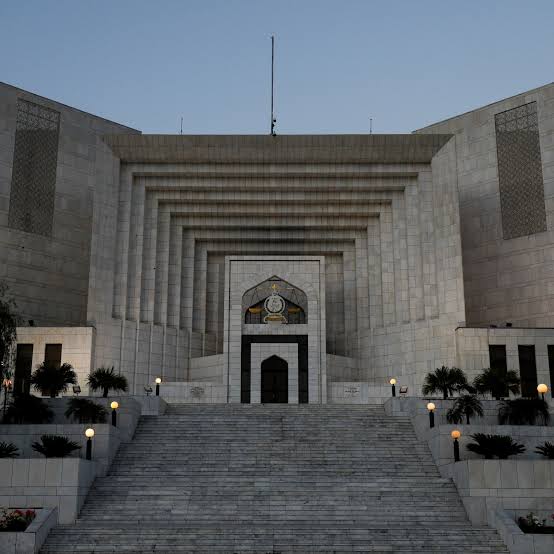
ISLAMABAD: In a landmark judgment reinforcing the constitutional and Islamic protection of women’s inheritance rights, the Supreme Court of Pakistan has ruled that a legal heir cannot be deprived of his or her rightful share in property through family arrangements, fraudulent transactions, manipulation of revenue records or social pressure. The verdict came while deciding a property dispute that had been pending for over seven decades.
A two-member bench headed by Justice Shahid Bilal Hassan, while allowing the appeal, overturned the earlier decisions of the lower courts, saying that the legal and Sharia right to inheritance arises immediately after the death of the deceased. The court observed that this right cannot be extinguished by custom, private understanding or unilateral actions of other family members.


The dispute related to the property of Roshan, who died in 1955. After his death, the inheritance was initially registered in the favour of all legal heirs through a conversion of inheritance. However, on the same day, another mutation was filed claiming that Roshan’s widow and daughters had verbally gifted their respective shares to his two sons.
According to the petitioners, no such verbal gift ever took place. They argued that the disputed conversion was fraudulently approved to deny the female heirs their rightful inheritance. Over the following years, the property was transferred to the descendants of the male heirs through deeds of exchange and gift, further complicating the ownership record.
The trial court dismissed the suit filed by the female heirs, and the appellate court as well as the Bahawalpur bench of the Lahore High Court upheld the decision. However, after perusing the record, the Supreme Court concluded that the disputed conversion could not withstand judicial scrutiny and declared it illegal, void and of no legal effect.
The apex court directed the revenue authorities concerned to immediately rectify the land records and complete the determination and distribution of inheritance shares among all legal heirs in accordance with applicable Islamic and legal laws.
In a detailed judgment, Justice Shahid Bilal Hassan observed that the law supports the protection of women’s inheritance rights and does not allow technical or questionable documents to undermine these rights. He noted that whenever the authenticity of an alleged gift is challenged, the burden of proof lies with those who claim the benefit of the transaction.
The judgment emphasized that Islamic inheritance law represents a carefully crafted system aimed at ensuring fairness and economic justice within families. It added that courts should exercise exceptional caution in cases where female heirs have been excluded from inheritance through alleged verbal gifts, acts of resignation or disputed income entries.
Justice Hassan also highlighted a persistent social challenge in Pakistan, observing that many women are deprived of their legal inheritance due to forged documents, manipulation of land records, forced family settlements and lengthy legal proceedings.
The court remarked that the denial of inheritance is not just a legal dispute but reflects broader social attitudes where women are often expected to give up rights granted by Islam and the Constitution in the name of family honour, tradition or social convenience. The judgment said that such practices are contrary to both constitutional values and the principles of Islamic justice.
The Supreme Court further said that the responsibility for protecting inheritance rights lies beyond the judiciary. Families, community leaders, religious scholars, legal experts, revenue officials and civil society all have a collective responsibility to ensure that the rights granted under Islamic law are respected and effectively protected.
Legal experts believe that the decision will serve as an important precedent in future inheritance cases, especially those involving female heirs. The decision is expected to strengthen judicial scrutiny of disputed property transfers and reinforce the principle that inheritance rights cannot be extinguished through fraud or discriminatory customs.