


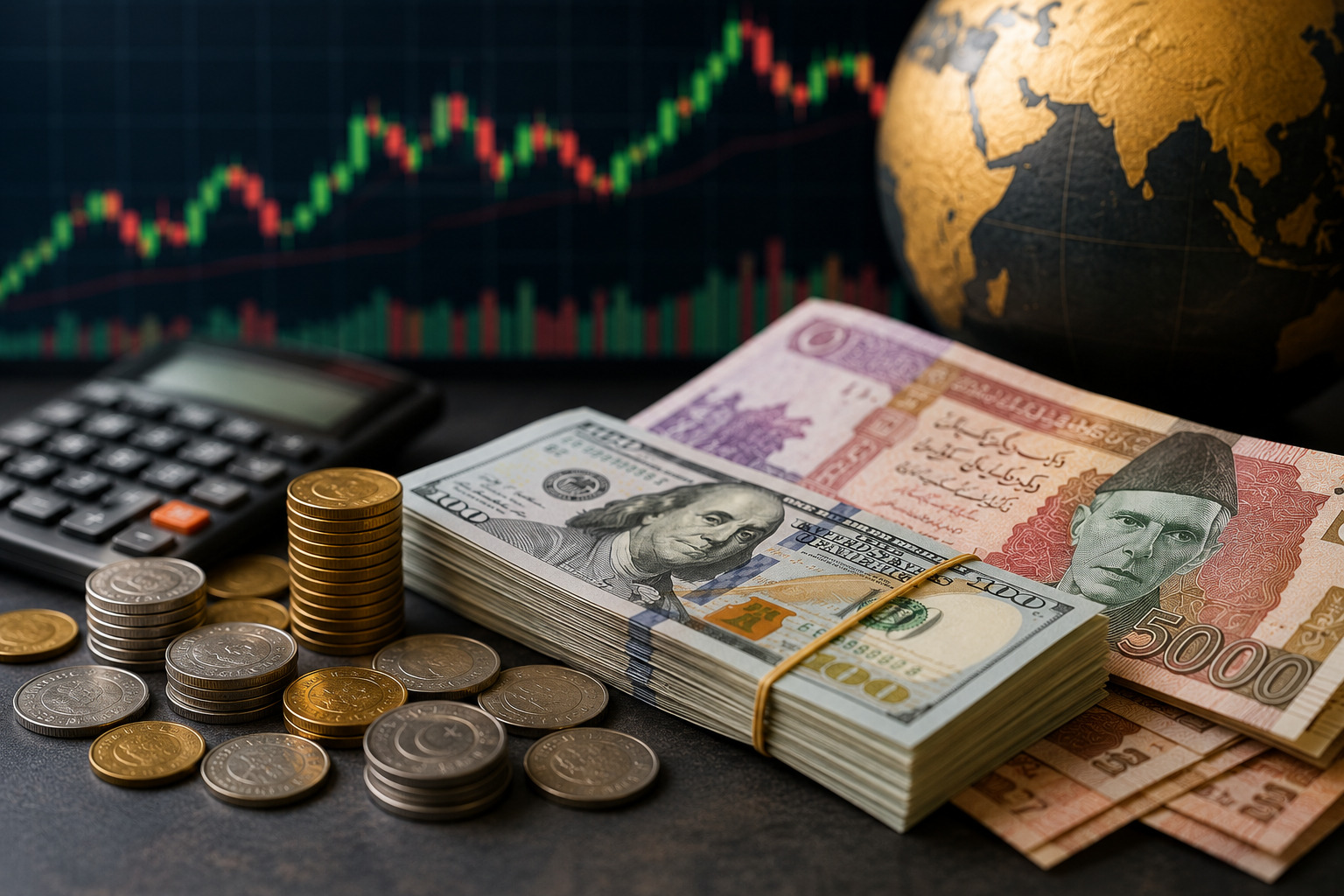
Karachi – Pakistan’s open market foreign exchange segment continues to show a mixed but relatively stable pattern as major global currencies trade within narrow but significant ranges against the Pakistani rupee.
According to the latest available rates, the US dollar is trading at Rs 278.45 for buying and Rs 279.35 for selling in the open market, reflecting a slight premium over the interbank level. Market activity is sensitive to demand from importers, travelers and currency exchange companies.
The British pound continues to maintain its position as one of the strongest currencies in the market, trading at Rs 373.92 for buying and Rs 378.90 for selling. The euro is also under pressure, trading between Rs 322.43 and Rs 328.45, reflecting the ongoing volatility in demand for the European currency.
Gulf currencies continue to play a significant role in Pakistan’s foreign exchange dynamics. The UAE dirham is trading between Rs 75.80 and Rs 76.80, while the Saudi riyal is trading between Rs 74.20 and Rs 74.80. These currencies are closely linked to remittance inflows, which remain a major contributor to Pakistan’s external accounts.
Other international currencies are also showing mixed movements. The Kuwaiti dinar remains among the most valued currencies at Rs 886.85 to Rs 896.99, while the Omani riyal is trading above Rs 720, reflecting the strong stability of the Gulf currency.
Financial analysts are noting that the volatility in the open market is being influenced by seasonal demand, import requirements and pressure from informal currency demand. Unlike the interbank market, open market rates often reflect real-time retail demand conditions, which are more sensitive to supply gaps.
Currencies such as the Chinese yuan, Canadian dollar, and Australian dollar are also showing moderate movements, indicating that global market trends are gradually filtering into Pakistan’s retail forex segment.
Market experts are suggesting that the behavior of exchange rates in the open market will depend on foreign funds, remittances, and regulatory oversight in the coming days.
Overall, the open market continues to reflect a controlled but demand-driven environment where currency values are adjusting within defined ranges rather than experiencing sharp fluctuations.
| Flag | Code | Buying (PKR) | Selling (PKR) |
|---|---|---|---|
 |
USD | 278.45 | 279.35 |
 |
GBP | 373.92 | 378.90 |
 |
AED | 75.80 | 76.80 |
 |
CHF | 346.94 | 351.95 |
 |
SEK | 30.27 | 30.57 |
 |
SGD | 214.65 | 219.64 |
 |
SAR | 74.20 | 74.80 |
 |
QAR | 75.04 | 76.35 |
 |
OMR | 722.00 | 732.32 |
 |
NOK | 27.88 | 28.18 |
 |
NZD | 160.15 | 164.88 |
 |
MYR | 67.05 | 67.90 |
 |
KWD | 886.85 | 896.99 |
 |
THB | 8.45 | 8.65 |
 |
JPY | 1.7114 | 1.8161 |
 |
INR | 2.80 | 3.10 |
 |
HKD | 35.01 | 36.01 |
 |
EUR | 322.43 | 328.45 |
 |
DKK | 43.39 | 43.79 |
 |
CNY | 38.05 | 38.80 |
 |
CAD | 197.57 | 207.05 |
 |
BHD | 736.75 | 747.85 |
 |
AUD | 193.79 | 198.75 |
We welcome your contributions to The Pakistan Observer. Submit your blogs, opinion pieces, press releases and news features to our editorial team.
Please send your submissions to our News Desk or Editorial team. We look forward to hearing from writers, journalists and contributors.