

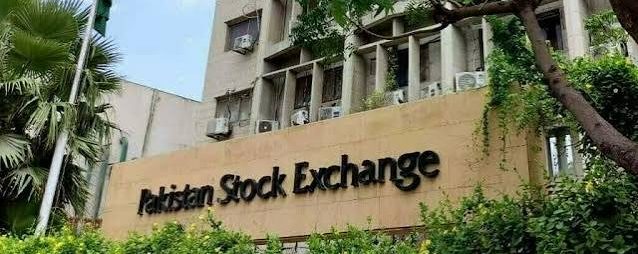
Karachi: Business at the Pakistan Stock Exchange (PSX) ended on a positive note on Monday, with the benchmark KSE-100 index recording a significant increase of 2,105.91 points on strong buying by investors. The market closed at 178,200.02 points, reflecting a 1.20 percent increase over the previous session.
During the trading session, the KSE-100 index opened at 178,460.72 points, while the day’s high was 178,985.95 points and the low was 177,759.88 points. The total trading volume of shares of companies included in the index was 255.20 million shares, reflecting significant investor activity in the market.
On the other hand, the KMI-30 index, which comprises Islamic shares, also performed strongly. The index closed at 251,278.11 points after gaining 4,080.05 points, showing a daily increase of 1.65 percent. The KMI-30 recorded a high of 252,009.89 points and a low of 250,125.78 points during the session, while the trading volume was 116.52 million shares.
FFC, MEBL, LUCK, PPL and ENGROH played a significant role in the positive performance of the market. These companies added the most positive points in the KSE-100 index, while the same shares significantly contributed to the index’s rise in the KMI-30.
On the contrary, Nestlé Pakistan, MCB, COLG, PKGS and IBFL had a negative impact on the KSE-100 index, however, their overall impact could not change the positive momentum of the market. HCAR was the only significant share in the KMI-30 index that had a minor negative impact.
According to the released market data, the calendar year to date (CYTD) return of KSE-100 was 2.38 percent while the financial year to date (FYTD) performance was negative 1.17 percent. Similarly, the CYTD return of KMI-30 was recorded at 1.10 percent while the FYTD performance was negative 2.35 percent.
According to market analysts, the index was supported by investors’ buying of large and core sector shares at the start of the trading week. According to them, in the coming sessions, investors will keep a close eye on the country’s economic indicators, corporate results, interest rate expectations and government economic policies, which can play a significant role in determining the future direction of the market.