

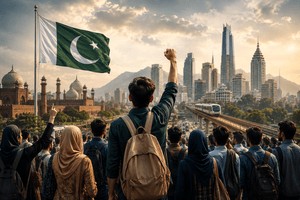
South Asia is currently not only going through a period of political or economic changes, but a new social reality is also emerging. Central to this reality is the younger generation, which is more educated, more informed and more connected to the digital world than ever before. This is the reason why today the youth are not just voters but have become an important force influencing politics, economy and governance.
In recent years, youth-led protests in several countries, including India, Bangladesh and Sri Lanka, have made it clear that inflation or politics alone are no longer the cause of popular backlash. Irregularities in the examination system, limited employment opportunities, questions on merit and loss of trust in government institutions can also trigger a major public backlash. Recent Indian protests have also evolved from a demand for examination transparency to a discussion of education reforms and government accountability.
The expectations of the young generation have changed significantly compared to the last decade. Today’s student doesn’t just want to get a degree; he also wants assurance that his hard work will be rewarded fairly. If trust in examinations, recruitment or educational institutions weakens, the impact is not limited to education, but public trust in state institutions is also affected.
Artificial intelligence, automation and the digital economy have also created a new reality for the youth. Many traditional jobs are changing while the demand for new skills is increasing rapidly. If educational institutions, universities and technical training centres are not able to prepare the youth for this change, the gap between degree and market requirement may widen.
The biggest question for Pakistan is not only unemployment but also “employable skills”. Millions of young people enter the job market every year, but industry, technology and service sectors don’t always match their skills. This difference can lead to frustration among young people.
On the other hand, social media has made the voice of the youth more powerful than ever. Now an exam irregularity, a recruitment objection or an incident with a student can become a national debate within hours. Therefore, in modern governance, it is not enough to just make decisions, but it is also necessary to take people into confidence in a timely and transparent manner.
Experts say that government jobs alone will not be enough to channelise the energy of the youth in a positive direction. Creating vast opportunities in areas like private investment, startup culture, digital business, freelancing, technology, the green economy and advanced technical education is the need of the hour. Equally important are the transparency of the examination system, merit-based recruitment and effective accountability.
The positive aspect for Pakistan is that the country has a large human capital in the form of a young population. If this capital is provided with quality education, modern skills, easy business opportunities and a transparent institutional framework, it is the youth who can accelerate the economy, increase exports and strengthen Pakistan’s role in the global digital economy.
The real success lies not in stopping protests but in not creating situations where the youth feel neglected. Effective governance, transparent institutions, equal opportunities and a system that listens to the voice of the youth form the basis of long-term stability for any state.
Recent experiences in South Asia suggest that the expectations of the youth have changed. The countries that will understand these expectations in time and improve their educational, economic and administrative policies will be able to transform their young population into the biggest force of development instead of a burden. Pakistan also has the same opportunity, and taking advantage of this opportunity in the coming years can be decisive for the country’s development.