

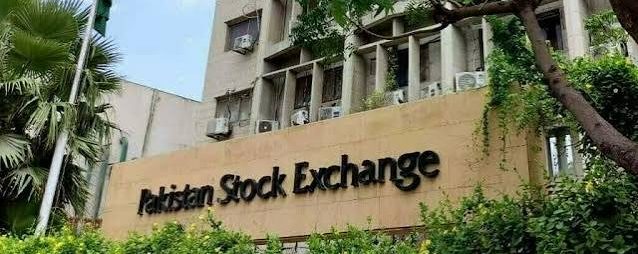
Karachi: Investors remained cautious during the trading session at Pakistan Stock Exchange (PSX) today, as a result of which both the major market indices, KSE-100 and KMI-30, closed in negative territory at the end of trading. Limited buying and profit-taking were the dominant trend in the market throughout the day, while investors kept a close eye on the domestic economic indicators, corporate activities and the situation in global financial markets.
Both indices witnessed minor volatility at the start of trading; however, selling pressure increased as trading progressed, weakening the overall direction of the market. Although buying was seen in shares of some companies, this positive trend could not prove to be enough to support the overall market due to selling in major sectors.
According to the data, the KSE-100 index opened at 188,012.67 points and reached a high of 188,126.68 points during trading; however, the index later fell to a low of 186,189.21 points due to selling pressure. At the end of trading, the index closed at 186,255.55 points, which shows a decrease of 1,199.14 points or 0.64 percent compared to the previous session.
Similarly, the KMI-30 index opened at 266,106.16 points and reached a high of 266,274.81 points in early trade, but later the index fell to a low of 262,898.89 points as the market witnessed a sell-off. At the close of trading, the KMI-30 index closed at 263,007.85 points, down 2,680.92 points, or 1.01 per cent.
Investors were also active in terms of trading volume. The total volume of shares of companies included in the KSE-100 index was recorded at 395.22 million shares, while the total volume of shares of companies included in the KMI-30 index was 128.24 million shares. According to market experts, although the market closed in the negative zone, the trading volume indicates that investors did not completely exit the market but continued to evaluate investment opportunities cautiously.
On an annual basis, both indices are still performing positively. As per the available data, the KSE-100 index has gained 3.30% since the beginning of the fiscal year and 7.01% since the beginning of the calendar year. Similarly, the KMI-30 index has remained positive at 2.21% during the fiscal year and 5.82% since the beginning of the calendar year, indicating that despite the recent decline, the long-term trend has not completely changed.
Looking at the performance of individual companies, BAHL was the most significant positive contributor to the KSE-100 index, gaining about 130 points. In addition, shares of HMB, IBFL, PSX and NBP also supported the index to a limited extent. On the other hand, shares of FFC, PPL, UBL, OGDC and LUCK saw significant declines, due to which the overall pressure on the index remained.
In the KMI-30 index, GHNI, PRL, NRL, PAEL and ATRL were among the prominent companies showing positive performance; however, selling pressure in shares of PPL, OGDC, LUCK, FFC and MARI played a major role in keeping the index down.
According to financial analysts, during the current trading session, investors adopted a cautious strategy instead of making new investments and were evaluating the possible impact of economic indicators, interest rates, rupee value, energy sector situation, global oil prices and upcoming policy decisions. Due to this, there was no large-scale buying trend in the market, while many investors preferred to take profits after the recent increase.
Experts say that short-term fluctuations in the stock market are a normal part of the market and should not be considered as a definitive indicator of the long-term trend. According to them, the performance of companies with fundamentally strong financial positions can remain the focus of investors in the future; however, investment decisions should always be made taking into account authentic financial information, company performance, economic conditions and individual financial goals.
Market participants say that in the coming trading sessions, investors will focus on the country’s economic progress, inflation trends, government economic policies, corporate financial results and the situation in global financial markets. Positive developments in these factors can improve market confidence, while if the uncertainty persists, there is a possibility of continued volatility in the short term.
Today’s trading session once again made it clear that although the market remained under pressure, investor interest has not completely disappeared. Buying in selected sectors, adequate trading volume and sustained positive performance on an annual basis indicate that investment opportunities exist in the Pakistan Stock Exchange; however, the direction of the market in the coming days will depend on economic indicators, fiscal policies and investor confidence.