

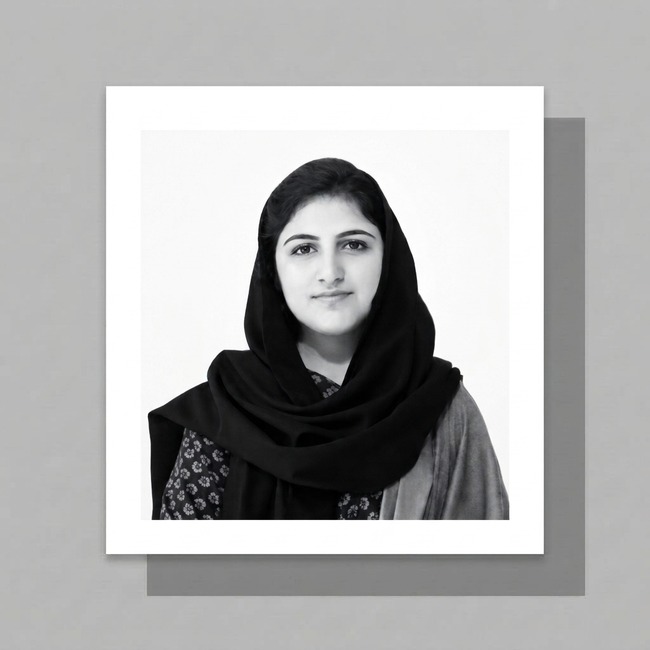
Rabia Ahsan’s Death Asks What Accountability Requires When a Firearm Takes a Life Inside the Home
A woman may spend half a lifetime becoming visible. One degree, one difficult assignment, one broadcast and one act of courage at a time, she builds a name the world finally learns to respect.
Rabia Ahsan did that work. She built a career in television, hosted current-affairs discussions, worked alongside senior journalists, entered entrepreneurship and raised two daughters. At 41, she was still writing the middle chapters of her life.
Then, on 8 November, a bullet struck below her neck inside her Rawalpindi home. The shot took less than a second. It did not merely stop a heartbeat; it threatened to reduce decades of effort to the final violent moment of her life.
That reduction would be another injustice. Before Rabia became the subject of an FIR, a remand hearing and television speculation, she was the author of a life: a broadcaster, professional, entrepreneur, mother, daughter, sister and colleague.
Did she build all of that only for a loaded pistol to erase it in a second? A biography takes decades to write; a fatal discharge can end its future in an instant. Public memory must not allow the final moment of her life to eclipse all that came before it.
The established facts remain limited. Rabia was found fatally wounded in the bedroom of her Gulshanabad residence. Police recovered a pistol reported to be unlicensed and arrested her husband, Ahsan.
FIR No. 1231/26 nominates him under Section 302 of the Pakistan Penal Code and Section 13(2)(a) of the Punjab Arms (Amendment) Ordinance 2015 for the alleged possession of an unlicensed firearm.
Her brother alleged that she had been shot; her husband has maintained that the discharge was accidental. His physical remand was extended while the investigation continued. No final forensic report or judicial finding had determined criminal liability by 11 November.
That uncertainty must govern public language. An FIR is not a conviction, suspicion is not proof and grief cannot replace evidence.
Yet the presumption of innocence cannot be transformed into a presumption that no serious wrong occurred. Legal caution requires restraint; it does not require moral evasiveness.
The question is not only whether death was intended but also how a loaded, allegedly unlicensed weapon came to end a woman’s life inside her home.
According to the account attributed to her husband, the couple were taking winter clothes from a cupboard when a pistol fell from the clothes and discharged.
The FIR presents a different immediate picture: after hearing the shot, Rabia’s sister reportedly entered and found her on the floor while her husband held the weapon.
Neither account is a judicial finding. The weapon’s location, loading condition, safety mechanism, trigger pressure, trajectory and muzzle distance must therefore be established through evidence.
These are not sensational questions; they are the evidentiary questions on which any reliable conclusion must rest.
The latest reported developments added information but not closure. On 11 November, police took the suspect to Lahore for a polygraph examination and sent mobile phones and post-mortem samples for forensic analysis.
Sources said an initial review of the couple’s chats revealed no evidence of domestic discord. This may matter to motive; it does not explain the mechanics of the shooting.
Nor is the absence of a quarrel evidence of safe firearm handling. Motive and mechanism answer different questions.
The polygraph must also be kept in its lawful place. In Muhammad Imran, alias Gochhi v. The State (2025 LHC 7145), the Lahore High Court held that such a test requires free and informed consent recorded before a magistrate and that consent obtained during physical remand is invalid.
It treated the result as an investigative or corroborative aid, not substantive proof of guilt. Any test in this case must be judged against those safeguards. Its results cannot substitute for physical evidence or judicial proof.
The reported absence of blackening around the wound makes firing distance important. Investigators should test the weapon for accidental discharge, forensically link the recovered cartridge case and any available projectile evidence, examine fingerprints and gunshot residue, and reconstruct the positions of those in the room.
The public does not need selective leaks. It needs a coherent chain of evidence capable of surviving cross-examination.
An accident is not a moral eraser. The inquiry cannot end with intention; it must also examine foreseeability, duty, causation and the chain of choices preceding the shot.
A firearm imposes an exacting duty because the foreseeable consequence of carelessness is death. Section 318 of the Penal Code defines qatl-i-khata as an unintended death caused by a mistake of act or fact; Section 319 provides for diyat and permits additional imprisonment where it results from a rash or negligent act.
The court must determine the legal category. The duty itself does not become uncertain merely because motive is disputed.
Responsibility begins before the trigger moves: acquisition, licensing, storage, loading, handling and muzzle direction all matter.
The discharge is the last link in a chain of choices, not the beginning of the story. The pistol’s reported unlicensed status is therefore not a technical footnote.
The home is private, but it is not a jurisdiction from which public law withdraws. Privacy protects intimacy; it cannot be converted into immunity.
A family may grieve in whatever way it can bear, but the state retains an independent duty to investigate a death and an alleged arms offence.
Rabia’s death also exposes a national contradiction. Pakistan celebrates women when they earn degrees, build businesses, host programmes and represent institutions.
Yet when danger enters the home, the language often changes: private matter, family issue, misunderstanding, accident.
We ask women to fight their way into public life while accepting that their safety may end at the front door. Rabia’s professional life was not incidental to this tragedy. Her achievement required discipline over years; the act that ended it required seconds.
The International Federation of Journalists’ 2025-26 Pakistan report found that women accounted for only 11 per cent of people featured in the country’s traditional news.
The figure does not measure newsroom employment, but it reveals the wider economy of visibility in which Pakistani women still struggle to be seen and heard.
Against that background, sustaining a public voice on screen carries particular significance.
Rabia’s two daughters should not have to encounter their mother’s final moments through leaked photographs, lurid thumbnails or invented marital histories.
Newsrooms should distinguish among the FIR, police claims, defence assertions, witness accounts, forensic findings and facts established in court. Accuracy is the final professional courtesy the media can offer a journalist who can no longer correct the record herself.
Reports about the family’s position have conflicted: Rabia’s sister said the family was seeking to withdraw the case, while her brother, who is the FIR complainant, later denied that any such decision had been taken.
Neither statement, by itself, determines the legal effect of a possible compromise.
Investigators should preserve forensic integrity and issue evidence-based updates at defined stages. Any future waiver or compounding must be considered under the provisions applicable to the offence ultimately proved.
In a qatl-i-amd case, Section 309 governs waiver of qisas and Section 310 governs its compounding, while Section 311 preserves the court’s power to impose ta’zir where all the victim’s wali do not waive or compound or where fasad-fil-arz is attracted.
Beyond this case, Punjab needs rigorous licensing enforcement, clear safe-storage requirements and meaningful penalties for reckless access to loaded weapons. A preventable death should lead to enforceable prevention.
With the family’s consent, the media organisations and colleagues familiar with Rabia’s work could preserve an archive of her broadcasts and create an annual mentorship initiative in her name for an early-career woman journalist.
Hosted by a newsroom, press club or university journalism department, it could begin modestly, through editorial mentoring and a short newsroom placement, rather than waiting for a large scholarship fund.
This would not answer how Rabia died. It would ensure that the professional life preceding her death continues to open a door for another woman.
Justice must establish how Rabia died. Memory has a different duty: to refuse to let the manner of her death become the measure of her life.
Whatever legal conclusion the evidence ultimately supports, the process must remain free from influence, speculation and procedural shortcuts.
Rabia Ahsan was a whole life before she was a gunshot. The bullet ended her future; it must not be allowed to rewrite her past.
The writer dedicates the following original verses to the memory of journalist Rabia Ahsan:
چراغِ جسم بجھے بھی تو روشنی نہیں مرتی
بدن تو خاک ہو، عورت کی خودی نہیں مرتی
جو اپنے عہد کے ماتھے پہ نام لکھ جائے
وہ ایک گولی سے تاریخ میں کبھی نہیں مرتی
- Sumreen Younas is an internationally recognised poet, emerging legal scholar, and a final-year law student at Fatima Jinnah Women University, Rawalpindi. Her commentary in leading Pakistani newspapers and journals explores law, human rights, social policy and the responsibilities of public institutions, with particular attention to access to justice, student welfare and institutional accountability.
- She received first place for an outstanding research submission through a U.S. Department of State GLO initiative involving a Fulbright Specialist and Emory University’s Center for the Study of Law & Religion.
We welcome your contributions to The Pakistan Observer, Submit your blogs, articles, press releases, news story pitches and news features.
Please send your submissions to our News Room or Editorial team.