

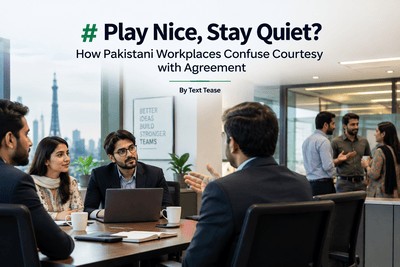
A familiar office scene goes like this.
Someone presents an idea in a meeting. The senior person in the room asks, “Any thoughts?” There is a pause just long enough to prove that everyone has thoughts. Then someone says, “Looks good.” Another person adds, “Makes sense.” The meeting ends.


Ten minutes later, the real meeting begins in the corridor, on WhatsApp, or over chai.
Suddenly, everyone has concerns.
The problem is not that Pakistani workplaces are uniquely incapable of disagreement. Every workplace has politics, hierarchy and people who would rather avoid an awkward conversation. But in Pakistan, respect for seniority, relationship preservation and the social cost of looking “difficult” can make disagreement especially expensive.
A meeting where everyone agrees immediately is not always a healthy meeting. Sometimes it is simply a room with a very clear org chart.
COURTESY IS USEFUL. COMPLIANCE IS SOMETHING ELSE.
There is nothing wrong with politeness. Work would become unbearable very quickly if every difference of opinion turned into a personality contest.
Courtesy helps people disagree without humiliating one another. It lets a junior employee challenge an idea without challenging someone’s dignity. It lets a manager reject a suggestion without treating the person who made it as a problem.
The trouble begins when courtesy quietly changes meaning.
“Be respectful” becomes “don’t push back”.
“Be professional” becomes “don’t make this uncomfortable.”
“Play nice” becomes “please agree” in a pleasant tone.
That distinction matters because an organisation can look extremely harmonious while accumulating very expensive mistakes.
HIERARCHY CHANGES THE PRICE OF SPEAKING
Research on employee voice in Pakistan has highlighted the role of hierarchy, psychological safety and the fear of negative consequences in shaping whether employees speak up. One study of 281 employees from six petroleum-sector companies in Karachi found that psychological safety mediated the relationship between ethical leadership and employee voice.
The logic is easy to understand. If your manager influences your appraisal, promotion, workload and reputation, disagreement is never just disagreement. It can feel like a career calculation.
A 2026 study of workplace-based assessment in Pakistani postgraduate medical education found a similar pattern. The research examined how hierarchy, fear of judgement, reputational risk and norms of deference could shape feedback and assessment interactions.
Different sector, same social mechanism.
So employees learn to edit themselves.
Not because they have nothing to say, but because they are calculating whether saying it is worth the cost.
THE POLITE EMPLOYEE CAN BECOME THE INVISIBLE EMPLOYEE
Pakistani workplaces often reward people who know how to read the room. That is a real skill. Understanding timing, tone and hierarchy matters.
But there is a difference between reading the room and disappearing inside it.
The employee who always says “no issue” can become the person whose issues are never seen. The colleague who keeps accepting unrealistic timelines may eventually be described as unreliable when those timelines collapse. The manager who never hears disagreement may conclude that the team is aligned when the team is simply cautious.
Silence can look remarkably similar to agreement from the top of a hierarchy.
That is why leaders need to treat disagreement as information, not attitude.
CLIENTS, GROUP CHATS AND THE PERFORMANCE OF AGREEMENT
The same habit appears outside formal meetings.
A client suggests something impractical. Nobody wants to say so directly, so the team spends three days trying to make the impossible look slightly more possible.
A senior person sends a late-night WhatsApp instruction. People respond immediately, not necessarily because it is urgent, but because silence itself might be interpreted.
A group chat reaches a bad decision through enthusiastic thumbs-up emojis.
None of this requires a villain. Most people are simply protecting relationships, avoiding embarrassment and trying to keep work moving.
But organisations pay for the things people were too polite to say early.
DISAGREEMENT DOES NOT HAVE TO BECOME THEATRE
The alternative is not a workplace where everyone argues all day.
Healthy disagreement is usually much less dramatic.
A manager can ask, “What are we missing?” instead of “Everyone okay?”
The most senior person can speak later rather than first, so the room is not immediately anchored to one answer.
Teams can criticise proposals without turning criticism into a verdict on the person who proposed them.
Managers can reward the employee who identifies a risk before it becomes a problem, even when that employee is inconvenient in the moment.
And employees can learn to disagree with precision: name the concern, explain the consequence, offer an alternative, then stop. No speech. No rebellion soundtrack. Just useful friction.
PLAYING NICE SHOULD NOT MEAN PLAYING SILENT
Civility is valuable, but it should not quietly become compulsory agreement.
That is the useful line for workplaces too.
Be courteous. Respect hierarchy without worshipping it. Protect relationships. Choose your battles.
But when something matters, say the thing.
A team that can disagree safely is not less respectful. It is usually more honest, more resilient and considerably harder to surprise.
The goal is not to eliminate politeness from Pakistani offices. We have enough problems without turning every Monday meeting into a courtroom.
The goal is simpler: stop confusing good manners with good judgement.
Sometimes the most professional sentence in the room is still:
“I don’t think this will work, and here is why.”
Then chai.
Text Tease is the author and publishing identity behind this workplace and social commentary piece.
Email: support@texttease.net
We welcome your contributions to The Pakistan Observer. Submit your blogs, opinion pieces, press releases and news features to our editorial team.
Please send your submissions to our News Desk or Editorial team. We look forward to hearing from writers, journalists and contributors.