


Each year, during the winter months in Pakistan, a thick layer of smog envelops major cities, negatively affecting the transportation network, public health, and outdoor living. This has become the most visible mark of this crisis in Lahore, but the issue is not just confined to Lahore but across Punjab and other urban centres as well. Smog is regarded as a seasonal nuisance, and sometimes crop-residue burning is cited as the sole cause. Both explanations are incomplete. The smog situation in Pakistan is a result of the long-term cumulative effect of human-induced emissions that aggravate weather conditions, thereby hindering the dispersion of pollutants. Even though climate change is putting additional strain on an already vulnerable environmental system, it shouldn’t be an excuse to ignore the pollution created within cities.
The difference between the source of the pollution and the conditions that cause the concentration of the pollution is very important. Pollution of fine particulate matter (PM2.5) such as vehicle exhaust, industrial combustion, brick kilns, waste burning and the use of polluting fuels are responsible for generating fine particulate matter. These particles are small enough to get into the lungs and can enter the bloodstream, where they raise the risk of respiratory and cardiovascular diseases. Particulate matter is one of the major health concerns of the World Health Organization. The Pakistan Air Quality Initiative (PAQI) 2025 national study indicated road transport, industry, and brick kilns as key sources of PM2.5 in urban areas of Pakistan. In Lahore, it was attributed to a large extent to transport, industrial activities, and brick kilns. This questions the way to attribute the seasonality to a single source.
The behaviour of these emissions after they are released is dependent on the weather. Temperature inversions can occur in the winter when a layer of warm air lies over a layer of cold air close to the surface of the Earth. This does little to encourage vertical mixing and causes pollution to be concentrated where people live and breathe. Additionally, they are limited by weak winds and stable atmospheric conditions, as well as possible haze formation resulting from the interaction of pollutants and humidity. Studies on the Lahore smog during winter have observed that low wind speeds and inversion layers are responsible for the continuation of smog events. That is, winter weather does not actually cause pollution; it sets the stage for the buildup of pollution that is already occurring.
So where does climate change fit in this equation? Increased temperatures and changes in precipitation, humidity, and atmospheric circulation may influence the conditions that lead to the build-up and maintenance of air pollution. High temperatures can speed the chemical reactions that create ground-level O₃ formation, and certain weather patterns can extend the times of stagnant air. But it is complicated: rain may flush some of the particles from the air, and the direction and force of the wind can disperse or carry pollution. Thus, it would be wrong to attribute all smog events to climate change or warming alone being the cause of the haze in Lahore during winter months. A better argument for a conclusion is that climate change is a risk multiplier, that is, it can make an already polluted environment more challenging to manage and that the intensity of the smog in the short term is closely linked to emission levels and local meteorology.
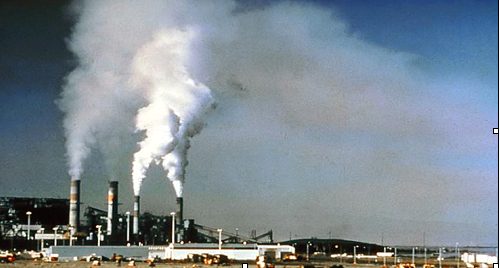
This interaction is exacerbated in the context of urbanisation. There is growing pressure on urban air due to the increasing number of vehicles, congestion, construction dust, energy demand and expansion of industrial activity. When the expansion of the road network is prioritised over the provision of quality public transport services, or when the development does not take into account the appropriate provision of dust protection measures and green space, citizens are trapped in a path of pollution. In informal settlements and low-income communities, individuals have less choice about where they live and so may be closer to other infrastructure that exposes them. The burden is not borne equally: those who work out of doors, use public transport or do not have access to filtration and health care are more likely to be at a higher burden.
The policy challenge in Pakistan is not a lack of policies but between policy promises and policy action. The National Clean Air Policy, adopted in 2023, includes targets for PM2.5 pollution reduction and actions in the transport, industry, agriculture, waste and household energy sectors. These priorities are good ones. However, a policy objective cannot reduce pollution in the air unless it is broken down into enforceable emission limits, credible monitoring, transparent public information, and consistent and clear penalties. School closures, traffic restrictions and anti-smog operations are only short-term measures intended to mitigate exposure during the most intense periods of an air pollution event and should not replace long-term emission control. Nor can the enforcement be directed toward small farmers and not be applied to the same degree to large industrial, transport and waste sources.
This is not sufficient: it needs to be accompanied by a public emissions inventory and independent verification of the monitoring of air quality. Authorities should consider the effects on industrial stacks, implement vehicle fitness and fuel regulations, speed up subsidising of public transport, provide practical solutions for farmers who cannot burn residues, and do more than just punish. The municipalities need to enhance waste collection to stop open burning and mandate dust management at building sites. Forecast systems should marry up air-quality data with weather information to ensure warnings are issued before pollution peaks to schools, hospitals and outdoor workers and vulnerable communities. Federal and provincial institutions should also have a shared airshed approach, as polluted air does not respect administrative boundaries.
Finally, Pakistan needs to recognise that smog is not just a winter issue and needs to treat it as a year-round public-health and urban-development challenge. While the effects of climate change can exacerbate the potential for pollution to persist, it does not excuse the emissions that are generated by the policy makers, industrial processes and/or cities. The proof of climate resilience is not when authorities declare restrictions on activities when the sky gets grey; it is when they lower pollution before the next winter. There will be a need for climate adaptation with cleaner air, but primarily there will be a need for sustained accountability.
Gul Shahzina Bano is an undergraduate student of BS Strategic Studies at the National Defence University, Islamabad. She serves as a research executive at Strategic Youth Paradigm. Her academic interests include international relations, geopolitics, strategic affairs and contemporary security challenges. She is interested in analysing emerging regional and international developments through a strategic and policy-orientated perspective.
We welcome your contributions to The Pakistan Observer, Submit your blogs, articles, press releases, news story pitches and news features.
Please send your submissions to our News Room or Editorial team.