

In 2006, my father brought home our first computer. I doubt anyone in the house thought that machine would decide the direction of my life, but it did.
I fell in love with it immediately. I spent hours experimenting with whatever software I could get my hands on, breaking things and then working out how to put them back together.
I was still a child, but I had already decided something that never changed: my career would be built on this machine.
Learning Before I Was Qualified to Learn
At fourteen, I enrolled in a six-month IT diploma. It was a modest course that taught the basics of website design, but it was the first time I understood that the things I had been playing with could be a profession.
At sixteen, I took a proper software development course and began working professionally soon afterwards. I had no degree and no permission from anyone to call myself a developer. I simply had the work.
During an internship, I was placed as an assistant developer on a cargo management system for a well-known Pakistani cargo company.
Over time, the project came to rest on my shoulders, and I ended up developing and deploying that system single-handedly. I was seventeen years old and had not yet started university.
My education did not follow a neat line. After intermediate, I paused my studies for two years because I was busy building software.
I began my degree in 2016 and completed it in 2020 from Virtual University, while continuing to work throughout.
In those years, I built accounting systems, ERPs, HRMS and CRM platforms, along with a long list of smaller tools.
I mention this because young people in Pakistan are often made to feel that a gap in their education is a permanent mark against them. It is not. What matters is what you are doing during that gap.
The Business That Almost Broke Us
In 2017, my first employer came to me with an idea. He had been my boss and then my mentor, and we had worked together on many freelance projects.
He is twice my age, and he wanted to set up a water filtration plant.
His reason was personal. His mother had died of hepatitis C after years of drinking contaminated water. He believed, with real conviction, that people deserved clean water, and he wanted to supply it directly to homes.
He needed a hand, and I joined him part-time.
From the outside, it looked simple. Hire staff, fill bottles, load them onto a vehicle, deliver them to customers and collect payment.
In practice, it was a nightmare.
Our riders were misusing fuel. Our bottles were disappearing with no trail of where they had gone. Some were being sold by riders, and sometimes by customers.
Payments stuck with customers hardened into bad debt.
Within six months, we had lost half our capital, not to a market crash or a competitor, but to revenue leakages and inefficiencies inside our own operation.
We were devastated.
Building the Fix
We had one advantage. We were both software developers, and the problem drowning us was, at its heart, a problem of information.
We could not see what was happening the moment our people left the premises.
So we built the software we needed.
It tracked riders and routes, tracked every bottle, optimised deliveries, and accounted for every rupee the business earned and lost.
I was the only developer on it.
We implemented it on our own operation first, and six months later the same business that had been bleeding capital was running on autopilot.
That was the moment the real lesson arrived.
Field operations are not a small administrative detail of a business. For thousands of Pakistani companies, they are the business, and almost none of them can see clearly what happens out there.
Realising It Was Not Only Our Problem
According to SMEDA, Pakistan has roughly 7.2 million businesses in the SME category. Around three-quarters of them are non-agricultural, and a large share of those depend on field operations at the core of what they do.
These companies are the backbone of our economy. They keep millions of households running.
And every year, a significant number of them close, not because their product was wrong or their market disappeared, but because their field operations were beyond their control.
They lose their capital the same way we nearly lost ours.
That is an avoidable tragedy, and it is happening quietly, business by business, all over the country.
In 2019, we launched our software publicly as Tarsil.pk for businesses that were as helpless as we had been.
The market responded.
By 2021, the product had been validated by real customers, and we formally registered the company.
Every year since, the platform has grown, and so have I as a developer, a business owner and an entrepreneur.
The Hardest Part Was Not Building the Software
When we decided to run Tarsil as a proper business, we discovered that writing the software had been the easier half of the task.
We were entering a market nobody had served.
We were offering a solution to SMEs, and they were not ready to buy it. To most of them, software was simply another expense, a cost to be avoided rather than an investment that would pay for itself several times over.
So before we could sell anything, we had to teach.
We had to sit with business owners and show them that a system would make their work easier rather than more complicated.
Many were also afraid of data theft. They did not want their sales figures, their customers and their cash positions sitting on somebody else’s computer, and that fear was reasonable.
We answered it by building a cloud platform hosted on some of the best servers in the world, with security we could defend without hesitation.
That decision cost us a great deal of money.
For a long period, we ran cash negative.
We were paying premium hosting costs, earning no profit, and putting everything we had into a product the market had not yet asked for.
I will say plainly that this stretch was harder than developing the software and deploying it on our own business had ever been.
Building a product is a problem you can solve alone at a desk. Convincing an entire market that it needs something it has lived without for decades is a different kind of difficulty altogether.
Through all of it, I was still the only developer on Tarsil.
I was building every new feature single-handedly and providing all of the technical support myself.
There were many sleepless nights. It was a complete roller-coaster ride.
What carried me through was not a business plan or a forecast.
It was a belief: that this system would one day bring ease into a great many people’s lives.
We had already watched it happen once.
The transformation we saw in our own water business after those six months felt like a small miracle, and the memory of it was stronger than the hardship we were passing through.
Where We Stand Today
Every one of those difficult years turned out to be worth it.
Tarsil is now used by more than 400 businesses across 77 cities of Pakistan.
More than PKR 33 billion in transactions have been recorded on the system.
Each month, we optimise around 20,000 kilometres of travel for our users, which saves fuel and reduces carbon emissions, and we have moved these businesses away from paper.
By our calculation, the annual environmental benefit is roughly equivalent to planting 1,100 trees.
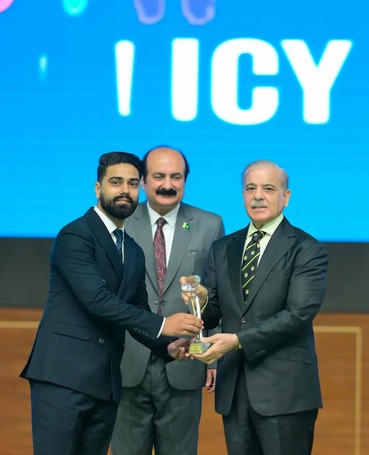
In recognition of this work, the Prime Minister of Pakistan awarded me the Youth Excellence Award in the Entrepreneurship category.
Beginning with website design at fourteen and receiving that award at twenty-eight has been an extraordinary journey, and it is not one I could have planned in advance.
The journey changed me as much as it changed the company.
I started as a developer who believed that a good product would speak for itself.
The years that followed taught me otherwise.
I learned how to explain value to someone who does not want to hear it, how to price a product honestly, how to survive without profit while protecting the people who depend on you, how to listen to a customer complaining about something I had built, and how to keep a long-term conviction alive through months when nothing in the numbers supports it.
None of that came from a classroom.
Every part of it was earned in the field, and it is what turned a software developer into an entrepreneur.
What I Would Tell a Young Pakistani Starting Today
If any of this is useful to someone reading it, let it be these lessons, each of which I learned the hard way.
Start before you feel qualified. I was working professionally at seventeen without a degree. Permission is something you give yourself; competence is something you build in public.
A pause is not a failure. I stopped studying for two years and graduated in 2020, years behind my peers on paper. Nobody has ever asked me about it. What you build during the gap is what people ask about.
Solve a problem you have felt yourself. We did not conduct market research to invent Tarsil. We built it because we were losing our own money and could not sleep. That kind of understanding cannot be borrowed.
What you cannot measure, you will eventually lose. Our fuel, our bottles and our receivables all disappeared through the same gap: no visibility. Measurement is not bureaucracy; it is survival.
Failure is information, not a verdict. Losing half our capital was the worst period of my working life. It also produced the product that now serves hundreds of businesses. The failure was not the opposite of the success; it was the raw material for it.
Building the product is rarely the hard part. Selling it to a market that does not yet know it needs it is far harder, and it takes years rather than months. Budget your patience accordingly, and be prepared to educate before you can sell.
Build for Pakistan as it actually is. The software that existed was not designed for how business is really conducted here, with cash, with trust, with verbal credit and long distances. Our advantage was never technical brilliance. It was that we understood the ground reality.
Keep your mentors close, and be willing to become their partner. My first boss became the person I built a company with. Relationships in this industry compound over decades, not months.
I do not come from a background that made any of this obvious or easy.
What I had was a computer in 2006, an unreasonable amount of curiosity, and a refusal to accept that the way things were done was the way they had to be done.
My life so far has been the clearest evidence I know of an old and simple idea: where there is a will, there is a way.
To every young Pakistani reading this who has an idea and no clear path to it, I would say only this.
The problem that frustrates you most is probably the business you are supposed to build.
Start there, start small, and start now.
About the Author
Uzair Wasif is the Co-founder & Chief Technology Officer (CTO) of Tarsil.pk, a Pakistani technology platform focused on helping businesses manage field operations through digital tools. He began his software development journey as a teenager and has worked across software development, business systems and entrepreneurship. His experience includes developing accounting systems, ERP, HRMS and CRM platforms before co-founding Tarsil.pk.
We welcome your contributions to The Pakistan Observer. Submit your blogs, opinion pieces, press releases and news features to our editorial team.
Please send your submissions to our News Desk or Editorial team. We look forward to hearing from writers, journalists and contributors.