

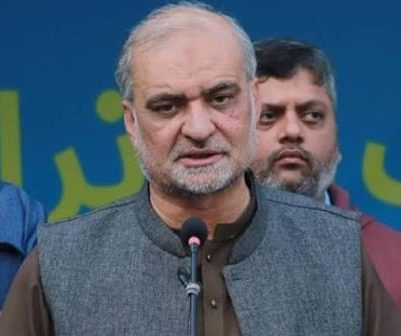
Peshawar – Jamaat-e-Islami Pakistan Ameer Hafiz Naeem-ur-Rehman has announced to continue the protest movement against the petroleum levy and asked the government to ease the extra burden on fuel. He said that Jamaat-e-Islami will continue protesting against inflation and the government should take into consideration the demands of the people.
Addressing a protest sit-in in Peshawar, Hafiz Naeem said that the repeated increase in petrol prices has increased the problems of the common citizens. According to him, the government should take an immediate decision on the issue of petroleum levy.
He called on the government to either eliminate or lower the tax on petroleum products. Hafiz Naeem said that a lot of money is being taken on a litre of petrol as tax and levy.
The official data shows that the price of petrol per litre has been pegged at Rs 325.43 from August 14. The petroleum levy on petrol at that time was Rs 80 per litre, and the levy on high-speed diesel was Rs 78.28 per litre.
Therefore, the Rs 130 tax imposed by Hafiz Naeem should not be interpreted as a petroleum tax but in the overall context of taxes and duties. The available official rates showed that the total taxes and duties on petrol were Rs 114 per litre.
Jamaat-e-Islami has been holding a protest movement against petroleum prices and inflation for the last few weeks. The party earlier announced nationwide protests, sit-ins on highways and other measures.
The recent protest is a part of this broader campaign. The primary demand of Jamaat-e-Islami is to lower the petroleum levy, ease the fuel prices and control inflation.
Jamaat-e-Islami aims to draw attention to public problems by staging protests, said Hafiz Naeem. He clarified that his party wants to adopt the path of political and public pressure instead of arson.
But he also cautioned the government that the protest could spread if it does not meet its demands. He said that he would consider organising an Islamabad march in the future.
Another significant part of the Jamaat-e-Islami protest is also the new petrol pricing mechanism. The government has started daily price adjustments in view of the rapidly changing prices in the global market. The rates are set by OGRA, taking into account various factors such as global prices and exchange rates.
This system enables the government to pass on international market fluctuations to local prices relatively rapidly. However, frequent price fluctuations can make it hard for consumers to plan.
Jamaat-e-Islami is exploiting this situation for public pressure. The party has already called for the government to lower the price of petrol and remove the levy.
It’s not an easy issue for the government. Petroleum levy is a major source of federal revenue, and a reduction in the levy can offer immediate relief to consumers. However, the action could put a strain on the government’s finances.
In the current situation, the real question is to what extent the government can provide relief to the people between global oil prices and the country’s financial needs. The decision to cut the petroleum levy will be significant not just in the political pressure context but also in the budget and revenues context.
Jamaat-e-Islami has said that if the government fails to make any headway on its demands, the protest will be further organised. The party’s recent statements also show that the strategy has been adopted to continue the sit-ins and protest activities until there is progress on the demands.