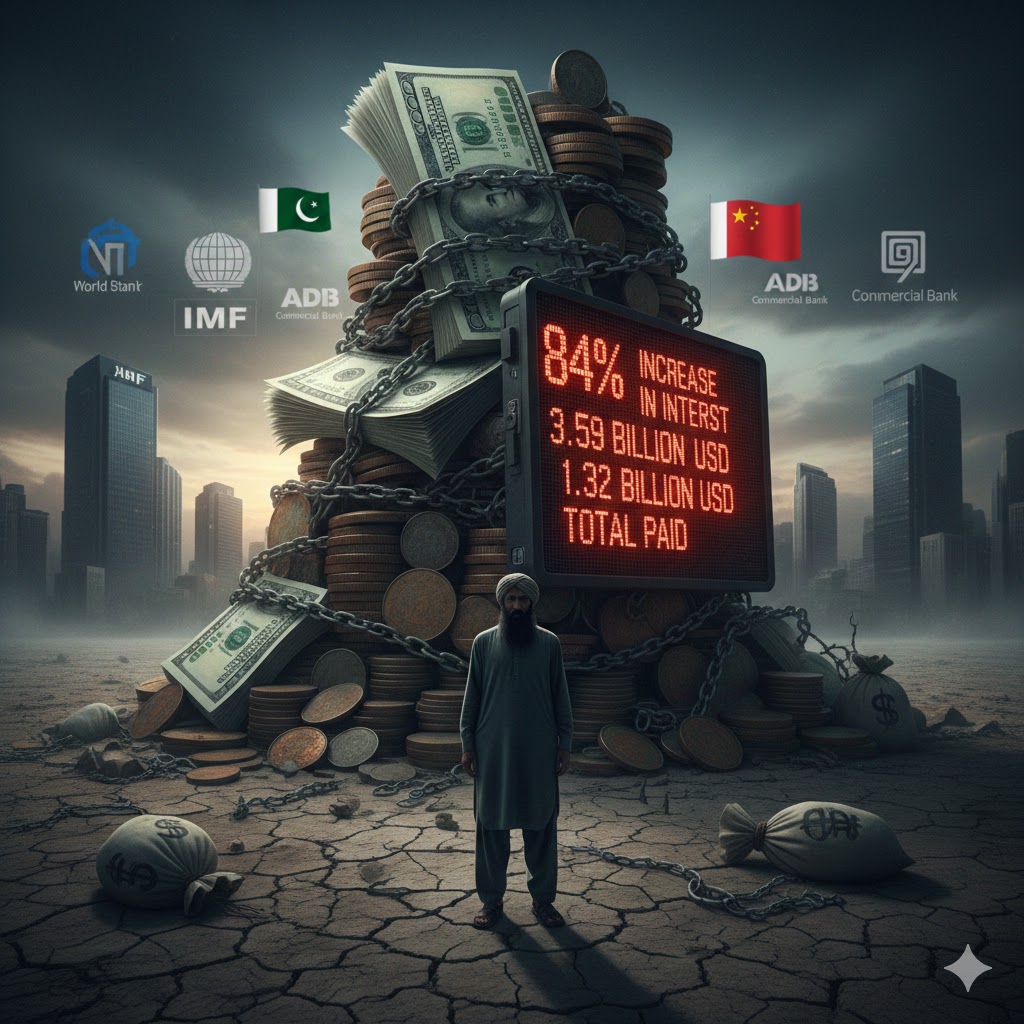

Karachi: Pakistan’s economy is currently at a critical juncture where the interest due on external debt has become a major challenge, more than the repayment of external debt. The latest documents issued by the Economic Affairs Division have raised concerns among economists and the public. According to these documents, there has been a sharp increase of 84% in interest payments on Pakistan’s external debt during the last three years. The data shows that the interest amount, which was at a low level three years ago, has now increased to $3.59 billion annually.
According to the document, a direct increase of $1.67 billion was recorded in interest payments last year compared to 2022. This situation is also worrying because Pakistan has to spend a large part of its total income only on debt servicing, i.e., interest and principal repayment. According to the report, Pakistan has paid a huge amount of $13.32 billion in loans during the year, including interest and principal. This amount is proving to be a huge burden on the country’s foreign exchange reserves and development budget.
The most important thing is that this interest was not only paid to traditional international institutions but also paid huge interest on deposits taken from friendly countries. According to the document, Pakistan paid interest to the IMF, the World Bank, the Asian Development Bank (ADB) and various global commercial banks. In addition, Saudi Arabia and China, which had been holding ‘safe deposits’ to support Pakistan’s foreign exchange reserves, were also charged interest. This shows that now ‘friendly loans’ are no longer free or cheap for the country, but their price also has to be paid according to the world market.
Although Pakistan has repaid a debt of $9.73 billion in the last three years, net external debt increased by $1.71 billion last year. The main reason for this is that new and expensive loans are being taken to pay off old loans. During the last fiscal year, Pakistan has signed new loan agreements worth $10.64 billion, which indicates that the country has not yet been able to get out of the debt trap. Experts say that this burden will continue to increase unless exports and foreign direct investment increase.