



The system operator’s new ten-year plan admits what engineers have known for some time: Pakistan’s power problem is no longer how much electricity it can generate, but how intelligently it can store, move and balance it.
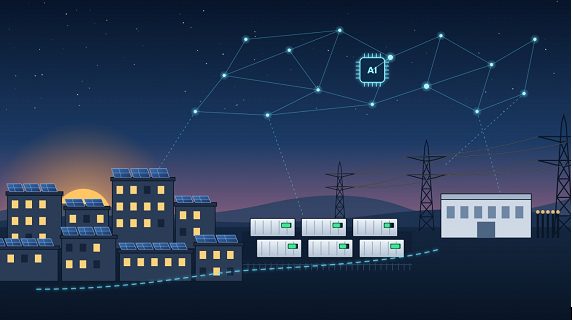
Graphical Representation: As the sun sets on Pakistan’s rooftop solar, demand climbs. Battery storage, a stronger transmission network and AI-enabled grid management can keep power reliable and affordable after dark.
As the sun sets on Pakistan’s rooftop solar, demand climbs. Battery storage, a stronger transmission network and AI-enabled grid management can keep power reliable and affordable after dark.
Pakistan has done something few countries have managed. Without a national subsidy programme, households, shops and factories have bought solar panels on a scale that has reshaped the power system.
By the end of the first ten months of FY26, cumulative solar panel imports had reached 54,711 MW, more than the country’s entire grid-connected installed capacity a year earlier. An estimated 51 GW of solar was operating by March 2026, and distributed solar generated about 51 TWh in FY2025.
The effect is now visible in official planning data. According to ISMO’s revised Integrated System Plan 2026–36, electricity generated on the national grid fell by about 13 per cent, from 154 TWh in FY2022 to roughly 134 TWh in FY2026, mainly because of distributed solar.
Yet peak demand rose to 27,169 MW in FY2026, about 40 per cent above the FY2016 peak. Customers with panels buy less from the grid at midday but still need it after sunset.
The 166-page plan, reported by Business Recorder on 23 November, says the country’s main power-sector challenge is shifting from generation adequacy towards system flexibility, transmission constraints and renewable integration.
ISMO has warned the government against committing to unnecessary new generation capacity. Put simply, Pakistan does not mainly need more power plants. It needs a grid that can cope with the plants, and the rooftops, it already has.
Solar is a strength that needs system planning
Households and businesses adopted rooftop solar largely because grid electricity is expensive and supply can be unreliable. That investment has cut bills and fuel imports.
But when many customers reduce their grid purchases at the same time, fixed network and capacity costs are spread across fewer units sold.
The State Bank of Pakistan has described this tension, alongside transmission limits, reverse power flows and the need for real-time monitoring, storage and more flexible operation.
The answer is not to treat customers’ solar panels as the problem. Pakistan should make the public grid valuable through dependable service, fair tariffs and the ability to exchange electricity safely.
Planning must measure behind-the-meter solar and actual feeder demand, rather than relying on outdated forecasts of grid sales.
The cost of an inflexible grid
The financial logic is stark. The system’s load factor has fallen from 67 per cent in FY2016 to 58 per cent in FY2026.
Every rupee of fixed cost is now recovered from fewer units of grid electricity, which pushes up the capacity charge on each unit. Government estimates put capacity payments to power producers at about Rs2,091 billion for the current fiscal year.
Higher per-unit costs push more customers who can afford it towards solar, leaving the remaining costs with those who cannot.
Adding plants that sit idle would make this worse, which is why ISMO’s plan selects no new fossil-fuel or imported-fuel plant under any of its three demand scenarios.
Demand has also become more peaky. The number of hours in which demand sits within 1,000 MW of the annual peak rose from 8 in FY2024 to 31 in FY2026, still only about 0.35 per cent of the year.
Building a power station to serve a few dozen hours of summer cooling demand is one of the most expensive ways to keep the lights on. Batteries, demand response, efficient cooling and better forecasting can usually do the same job for much less.
The evening cliff and the March minimum
Solar creates two new stress points. The first is the evening ramp. When the sun sets, rooftop output disappears within an hour or two and grid demand climbs steeply.
ISMO notes that many existing thermal plants cannot follow this ramp because of their technical limits and start-stop restrictions.
The second is the spring minimum. During low-demand conditions in March, the plan finds that losing the largest generating unit could push system frequency below the Grid Code limit of 49.3 Hz unless battery storage is available to respond.
This is why the plan proposes 1,740 MW of battery energy storage by FY2036. That comprises 1,000 MW for the National Grid in two 500 MW phases, with a minimum essential tranche of 1,000 MW / 2,000 MWh by March 2029, plus 300 MW for K-Electric, 360 MW in Gwadar and 80 MW under bilateral contracts.
Further deployment depends on studies of dispatch, thermal-plant flexibility, time-of-use tariffs and demand-side management.
Use batteries where they solve a measured problem
Grid-scale batteries do three jobs. They move surplus midday solar into the evening peak. They provide fast frequency response as solar displaces spinning machines and reduces system inertia. And they can relieve congested transmission and distribution assets.
What they deliver depends on their power rating, stored energy, state of charge, inverter controls and dispatch rules.
In September, NEPRA excluded a proposed USD 900 million battery investment from its approval of the previous plan and asked for a full technical and economic study of size, duration, location and cost-effectiveness.
The regulator was right to ask for evidence. The new plan’s frequency and ramping findings are that evidence beginning to arrive, and the study should now be completed quickly.
The 1,740 MW figure is a planning signal, not a reason to buy a single undifferentiated block of batteries.
Each project should be selected through a transparent assessment of location, duration, connection strength, expected cycling, degradation, replacement costs and the services it will be paid to provide.
A battery near a constrained load centre may defer an urgent network upgrade; another location may be better for shifting midday solar into the evening.
These benefits must be demonstrated with hourly network and dispatch modelling, then measured after commissioning.
Storage should also be weighed against demand response, flexible industrial loads, efficient cooling, pumped hydro where suitable and better coordination of existing generation. A portfolio can cost less and perform better than asking batteries to solve every problem.
The Lahore warning: why one technical line matters
The most important sentence in the report may be the least noticed. ISMO flags that the short-circuit ratio at the Lahore HVDC converter could fall below 3 under low-demand conditions and says this needs further technical assessment.
The ±660 kV Matiari–Lahore link is Pakistan’s first HVDC line, a 4,000 MW connection that carries power from the south to the load centres of Punjab. It uses line-commutated converter (LCC) technology.
LCC inverters depend on a strong AC network to switch their thyristor valves reliably. Engineers measure that strength with the short-circuit ratio (SCR), which compares the AC grid’s fault level with the converter’s rating.
Below a value of about 3, a system is generally regarded as weak. A weak grid raises the risk of commutation failures, voltage instability and temporary interruptions in power flow when faults occur on the AC network.
A disturbance on a 4,000 MW link feeding Lahore is not a small event.
Here is the hidden side of the solar success story. Rooftop solar displaces conventional generators during the day, and when demand is low, fewer large spinning machines are connected.
Those machines give the grid its fault level and strength. The grid therefore becomes weakest at exactly the moments when the sun is shining and demand is low.
The Lahore finding deserves a focused assessment across credible operating conditions, including minimum demand, high distributed-solar output and outages of major generators or lines.
Engineers should examine converter controls, interactions with nearby inverter-based resources, fault performance, protection coordination and dynamic stability before choosing a remedy.
ISMO’s proposed measures are sensible: STATCOMs, reactors and capacitors for voltage control, and converting retired or retiring power plants into synchronous condensers, which strengthen the grid without operating as ordinary generators.
Pakistan should also evaluate grid-forming batteries. Conventional grid-following inverters take their cue from the network. Grid-forming converters set their own voltage and frequency reference and can provide fast frequency response, inertia and support for weak grids.
Great Britain offers a working precedent: under its Stability Pathfinder programme, the system operator contracted five synchronous condensers and five grid-forming batteries to provide short-circuit level and inertia in Scotland.
If part of the 2029 battery tranche is sited near weak nodes such as the Lahore converter, and grid-forming capability is written into the tender, one asset could handle the evening ramp, provide frequency response and support system strength.
There is a caveat. Inverters supply far less fault current than rotating machines, so detailed electromagnetic-transient studies are essential.
The options should be compared on cost, response and technical effectiveness; a combination of condensers and grid-forming storage is likely to be the most robust answer.
Where AI fits, and where it does not
Artificial intelligence is not a substitute for sensors, communications, accurate network models or trained system operators. It is most valuable where data already exists and decisions have to be made often.
Four uses stand out for Pakistan.
Seeing the invisible solar. Business Recorder analysis found that at least 86 per cent of imported panels never appeared as formal net-metered connections, so operators forecast demand without seeing most of the generation behind it.
Machine-learning models that combine satellite imagery, weather data, feeder measurements and meter readings can estimate behind-the-meter solar and forecast net demand at feeder and substation level.
In Great Britain, the system operator’s AI-based solar forecasting tool halved forecast errors, worth at least £30 million a year in reduced balancing costs.
Operating batteries and demand intelligently. Optimisation tools can schedule storage to balance evening-peak value, frequency services and battery life.
They can also support the time-of-use tariffs and demand-response programmes that ISMO’s proposed national demand-side management strategy envisages, for example by moving agricultural pumping and cooling loads.
Managing the evening ramp. Dispatch-support tools can help operators plan for the steep evening ramp within the flexibility limits of thermal plants.
Watching weak points in real time. Digital twins and synchronised measurements can track grid strength near critical assets such as the Lahore converter, detect voltage problems and reverse flows where rooftop solar is concentrated, and support predictive maintenance of transformers and lines.
The raw material is arriving: more than 2.12 million smart meters had been installed by August 2026, and the government has engaged the IFC to help roll out about 10 million more.
Data quality comes first. Forecasting tools should be tested against simple baselines, report their uncertainty and be monitored across seasons and regions.
High-impact actions, such as switching equipment, changing protection settings or dispatching reserves, must stay within approved operating limits and accountable human procedures. Cybersecurity, data access controls and clear audit trails are essential.
Make reliability and affordability the test
The government, regulator, system operator, utilities and investors should judge each intervention by public results: fewer interruption hours, less renewable curtailment, lower system losses, better voltage and frequency performance, better use of existing generation, and a transparent effect on consumer bills.
Procurement should publish the service required, the alternatives considered and the performance expected. Data should then show whether the promised benefits were delivered.
Pakistan’s citizens have already led the energy transition with their own money. The next phase belongs to system planners, regulators and engineers.
Pakistan does not need to choose between rooftop solar and a reliable public grid. It needs a grid designed around the electricity system that now exists.
Batteries can shift energy, stronger networks can deliver it, and well-governed AI can help operators see and manage the system sooner. Together, these cost less than new power plants and can make the solar boom an asset rather than a liability.
Key figures at a glance
| Indicator | Figure |
|---|---|
| Cumulative solar panel imports (end of 10MFY26) | 54,711 MW |
| Estimated operating solar capacity (March 2026) | About 51 GW |
| Distributed solar generation (FY2025) | About 51 TWh |
| Grid generation, FY2022 to FY2026 | 154 TWh to approximately 134 TWh |
| Peak demand, FY2026 | 27,169 MW |
| System load factor, FY2016 to FY2026 | 67% to 58% |
| Hours within 1,000 MW of annual peak, FY2024 to FY2026 | 8 to 31 hours |
| New fossil or imported-fuel plants selected in ISP 2026–36 | None |
| Battery storage proposed by FY2036 | 1,740 MW |
| First essential National Grid battery tranche | 1,000 MW / 2,000 MWh by March 2029 |
| Lahore HVDC converter short-circuit ratio | Could fall below 3 at low demand |
| Transmission investment to FY2036 | About USD 9.18 billion |
| Estimated capacity payments, current fiscal year | About Rs2,091 billion |
| Smart meters installed as of 5 August 2026 | More than 2.12 million |
Figures from ISMO’s ISP 2026–36 are as reported by Business Recorder on 23 November 2026. Numbers in brackets in the original manuscript refer to the author’s source material.
Dr Habib Ur Rahman Habib (SMIEEE, MIET) is a UK-based energy innovation scientist. With over 16 years of international academic, research, and teaching experience across Pakistan, China, Europe, and the UK, his expertise spans power systems, power electronics, HVDC, renewable-energy integration, energy storage, intelligent grids, and AI-enabled energy systems.
He is a Pakistan Engineering Council Professional Engineer and an HEC-approved PhD supervisor. He can be reached at habib_rahman_habib786@yahoo.com.
The views expressed are the author’s own.
We welcome your contributions to The Pakistan Observer, Submit your blogs, articles, press releases, news story pitches and news features.
Please send your submissions to our News Room or Editorial team.