


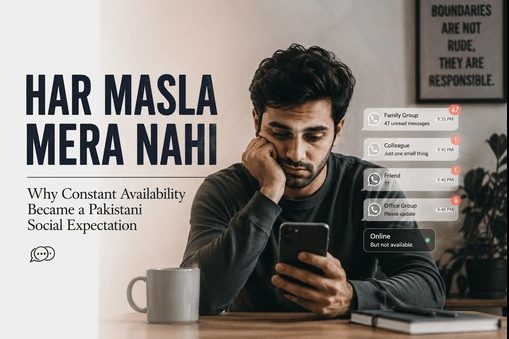
A phone can be silent and still feel demanding. The family WhatsApp group has 47 unread messages. A colleague has sent “just one small thing” after office hours. A friend has followed up with a second message because the first one has been sitting there for twenty minutes. Nobody has explicitly said you must reply now, but the expectation is already in the room.
That is one of the strange social changes of being permanently connected. Availability used to be physical. If you were at home, at work or sitting across from someone, you were available. Now a blue tick, an online indicator or a phone in your hand can make people assume access even when your attention is somewhere else.
In Pakistan, where family, work and social circles often overlap heavily, that pressure can feel especially familiar. A delayed reply may be read as attitude. Muting a group can feel rude. Ignoring an after-hours office message can feel risky. The result is a new kind of invisible duty: if you can be reached, you should respond.
Connected enough for silence to become noticeable
Pakistan’s digital life is large enough for this tension to be ordinary. DataReportal’s Digital 2026 Pakistan report estimated 117 million internet users at the end of 2025 and 79.9 million social media user identities in October 2025. Those figures do not mean everyone is online all day, but they do show how deeply digital communication now sits inside everyday life.
The technology itself is neutral. The social interpretation is not. A messaging app can show that a message was delivered or read, but people often turn that tiny piece of information into a story: you saw it, so why did you not answer? The gap between presence and obligation begins to disappear.
Work turned responsiveness into a performance
The workplace makes the issue sharper. In March 2026, Dawn reported on a Kaspersky survey across the Middle East, Turkiye and Africa in which 83 percent of respondents said they kept an eye on office work outside working hours. Eighty-five percent said they replied to work-related messages on instant-messaging apps outside working hours, and the same share checked work email during off-hours.
Those percentages are regional, not Pakistan-only statistics, so they should not be treated as a national measurement. But the pattern is recognisable: digital tools make it easy for work to cross the door without physically following you home.
The problem is not one late message. It is the habit that forms around it. A manager sends something at 9:30 p.m. because they happened to remember it. An employee replies because they do not want to look uncommitted. The manager now learns that 9:30 p.m. works. Soon the exception becomes an unwritten norm.
Research published in Scientific Reports in May 2026 points to the wider cost of this pattern. In a study of 200 Korean office workers, intensive use of enterprise social media was associated with communication overload and boundary-management stress, which were in turn linked with greater exhaustion and lower well-being. It is not a Pakistan-specific study, but it captures the mechanism clearly: constant connectivity can make it harder to psychologically leave work.
Family and friendship can create the same pressure, just more politely
Workplace pressure is easier to name because it has a boss. Social pressure is softer.
A family group wants an acknowledgement. A friend expects a reaction. Someone sends “??” because your silence has become information. In close relationships, responsiveness is often a form of care, and that is worth protecting. But care and permanent access are not the same thing.
There is also a difference between ignoring people and answering on your own time. A Text Tease essay on digital boundaries and being deliberately unavailable makes the same point in a Pakistani context: online presence is not consent to immediate access.
The distinction is simple, but it matters: reachable is not the same as available. Your device may be connected while your attention is occupied, your energy is low, or you simply do not want to enter another conversation yet.
Har masla mera nahi
This is where the phrase becomes useful. Har masla mera nahi does not mean refusing to care. It means refusing to treat every notification, request, opinion, emergency-shaped message and “quick favour” as your automatic responsibility.
Many people become the reliable one in a family, office or friend group. Reliability is a strength until it quietly becomes a permanent job description. The person who always replies becomes the person everyone expects to reply. The person who always fixes becomes the person everyone sends the problem to.
Boundaries interrupt that pattern. They can be small and almost boring: muting a non-urgent group, not answering work messages after a certain time, saying “I will check this tomorrow,” turning off read receipts where appropriate, or letting a message sit without manufacturing an excuse.
None of these actions require a dramatic digital detox or disappearing from society. They simply restore a little friction between someone else’s request and your response.
The goal is not to become unavailable. It is to make availability intentional
There is a temptation to frame boundaries as withdrawal, especially in a culture where warmth and responsiveness are valued. But a boundary can actually protect those qualities. If every message feels like an obligation, even people we like can begin to feel like demands. If we are allowed to choose when to engage, the engagement itself can become warmer and less resentful.
The healthiest version of digital life is probably not total silence. It is selective access. Reply when the matter is urgent. Be present when a person genuinely needs you. But let routine requests wait. Let non-urgent work stay at work. Let a family group survive without your immediate thumbs-up emoji.
Being responsive is generous. Being permanently on call is something else. A phone can make us reachable every minute of the day, but it cannot decide how much of us everyone else is entitled to.
Sometimes the most reasonable answer to a notification is simply ‘kal dekhte hain’. Har masla mera nahi.
About the Author
Text Tease is a fashion- and art-led social-expression brand exploring digital culture, personal identity, boundaries and the changing ways people connect. Its editorial work examines everyday social behaviours and contemporary communication through humour and cultural observation.







Baat tu Sahi hai, makes sense